Notes
Matches 101 to 150 of 1,340
| # | Notes | Linked to |
|---|---|---|
| 101 | Career "Moor-master under Lord Derwentwater" ( | Lee, William (I2291)
|
| 102 | Career Lord Major of London 1602-3 (https://www.british-history.ac.uk/no-series/london-aldermen/hen3-1912/pp168-195), Robert was knighted in 16031 Footnotes [1] https://www.british-history.ac.uk/vch/warks/vol3/pp58-61 | Lee, Sir Robert (I1750)
|
| 103 | Career One of the Judges of the Common Pleas. From
All the rest, especially John Arch Deacon of Sarum, and Canon of Exeter, were very well advanced. Eleven Daughters married to the most potent Families in this County, and most of them Knights: So that (what is said of Cork in Ireland, that all the Inhabitants therein are Kinne) by this Match almost all the Ancient Gentry in this County are allied. The Portraiture of Sir Lewis and his Lady, with their two and twenty Children, are set up in a Glasse Window at Nimet-Bishop. There is a Tradition continued in this Family; that the Lady glassing the Window in her husbands absence at the term in London; caused one child more then she then had, to be set up, presuming (having had one and twenty already, and usually conceiving at her husbands coming home) she should have another child; which inserted in expectance, came to passe accord∣ingly. This memorable Knight died Anno 15402. Footnotes [1] History of the Worthies of England. By Thomas Fuller, D.D. Folio. London, 1662, see here [2] There are a few errors in this profile; firstly, the date of death given is wrong, in so far as contemporary sources (e.g. Wikipedia all give 1526 not 1540. Secondly, the name of Lewis' wife was Agnes, not Elizabeth. | Pollard, Sir Lewis of Girleston (I2343)
|
| 104 | Career Per Also had another daughter (Anne) who married Sir William Scroggs the younger, and a son Matthew Bluck who married Katherine Hawkins. Note that the Scroggs family connects here but also through William Gilby, Recorder of Lincoln who was son of Elizabeth Scroggs. From The historical antiquities of Hertfordshire, Volume 1: William Lord Willoughby, about the year 1671, sold his Mannor with the Advowson of this Church to Matthew Bluck, Esq. Secondary of one of the Counters in London, Usher of the Rolls, and one of the six Clerks in Chancery; he married one of the daughters of Sir William Martin in the County of Essex, Kt, by whom he had Issue Matthew, and two daughters; one married to Sir William Scroggs of Grays inn, Kt, and the other [Elizabeth] married --- [William] Gilby, Esq. And upon his decease, his son Matthew did succeed him. He [Matthew the son] married Katharine the eldest Daughter of Sir Richard Hawkins of Middle Aston in the County of Oxford, Kt, who was Alderman of the city of London, and gives for his Arms, a Lion Rampant. Annoyingly, I can't find any evidence of the marriage with Elizabeth Martin. | Bluck, Matthew (I1699)
|
| 105 | Death ARCHIBALD MURDOCH of Brae of [Cessant], wife ANNE MOIR, son Archibald of Gartincaber (wife ANNE MAULE, children JAMES, MARGARET & JEAN) | Murdoch, Archibald in Brae of Cessintully (I0841)
|
| 106 | Death His will, dated 8th December 1779 and proved on the 7th of September 1780, starts: John Sutherland, Captain in his Majesty's 11th Regiment of Foot, commanded by General William A Court Ashe [sic] and now quartered in the Barracks of Dublin in the Kingdom of Ireland Then names his wife Mary Elizabeth nee Williams, and a son from a former marriage, John Barber Sutherland. | Sutherland, Capt. John (I1636)
|
| 107 | Death B 17[4]3. John MURDOCH 18.1.17(42] 37, wife Margaret McNIVEN 23.12.1756 59, son JAMES died Bridge of Teith 29.9.1822 86 (wife Beatrix CAMPBELL 5.2.1817 77). Also John MURDOCH (father captain J. C. MURDOCH) died Edinburgh 23.1.182[3] [3] y 2 m | McNiven, Margaret (I1986)
|
| 108 | Death A memorial inscription at In memory of ELIZABETH wife of JAMES MICKLETHWAITE of Hopton Hall who departed this life May 24th 1822 aged 58 years. Also the above JAMES MICKLETHWAITE who departed this life on the 24th day of September 1824 aged 71 years. Also of ANN daughter of the above who departed this life March 24th 1828 aged 34 years. Also of ELIZABETH daughter of the above who departed this life Nov 14th 1867 aged 78 years. Footnotes [1] Available from www.kirkheaton.info | Oxley, Elizabeth "Betty" (I2594)
|
| 109 | Death A memorial inscription1 at Here are interred the remains of Benjamin son of DANIEL MICKLETHWAIT of Hopton who died December the 16th 1762 aged 32 years. Improve your time for it flies away apace. Also the body of Dan.l MICKLETHWAIT, father to ye abovesaid Benjamin who departed this life the 8th day of April 1765 in ye 84th year of his age. Also the body of Mary wife of the abovesaid Daniel who departed this life ye 7th day of July 1780 in ye 96th year of her age. Also the body of Dan.l son to the above Daniel and Mary who departed this life the 18th of October 1780 in ye 59th year of his age. Also the body of John son to ye above Daniel and Mary who died May the 12th 1786 in the 69th year of his age. Here lieth interr’d the body of Ann wife of the abovesaid DANIEL MICKLETHWAIT of Hopton Junr who departed this life the 12th day of July in the year of our Lord 1762 and in the 58th year of her age. Footnotes [1] Available from www.kirkheaton.info | Micklethwaite, Daniel (I2596)
|
| 110 | Death An entry for the 9th January 1706/7 in Journals of the House of Commons Vol. 15 indicates that Arabella was still alive: A Petition of Dame Arabella Edwards, Widow and Relict of Sir John Edwards, of Heath House, in the county of Salop, Knight, deceased, and Arthur Edwards, her Son, was presented to the House...setting forth that the said Sir John, some short time after his Marriage, settled several Lands and Tenements upon himself, and the Petitioner, for Life, Remainder in Tail Male, with a Power to charge the Premises with Portions for younger Children; that Sir John died in February 1704, leaving Issue the Petitioner Arthur, and two Daughters, all infants... | Heath, Arabella (I2026)
|
| 111 | Death Announcement in The Times, 11th December 1937: Burn-Murdoch On Dec 9 1937, at Gartincaber, Doune, Perthshire, Anne Regiaulde de Maule Burn-Murdoch, MBE, the loved wife of TM Burn-Murodch MB FRCPE of Gartincaber and only daughter of the late Captain W Brabazon Urmston RN, aged 81 years | Urmston, Anne Regiualde de Maule (I2082)
|
| 112 | Death Died c. 1768, as described in the inscription1 on the Bolland vault at Masham Church: Near this spot rest the mortal remains of John BOLLAND, of Masham, gent; also of Margaret his wife, and of six of their children. He was for many years a respected inhabitant of the town of Masham, and having survived his wife eight years he died a.d. 1776, aged sixty-one. Footnotes [1] John Fisher: The History and Antiquities of Masham and Mashamshire; publ 1865; page 407 | Procter, Margaret (I1545)
|
| 113 | Death From Thomas Portington, the head of the family, had a little before that date been slain in his house at Barnby, an event attended with some remarkable circumstances. The house of York had still many friends in the county from which their title was derived, after the battle of Bosworth; and particularly in the neighbourhood of the chase of Hatfield and the castle of Coningsborough, it might be expected that there would be no ready acquiescence in the rule of the house of Lancaster. We have seen Morton of Bawtry arming himself for the field against the earl of Richmond; and we now find Portington of Barnby a party in that last effort to support a falling cause, which ended in the decisive battle of Stoke. After that battle, he seems to have retired with some of the vanquished party to his house at Barnby, and there to have maintained himself for some time against the king's authority. Two privy seals commanding him to repair to the king he resisted, and treated with indignity the serjeant at arms by whom they were delivered: and when the king issued his warrant to sir Richard Tunstall the steward of Pontefract, and to the high sheriff, to bring his body, and the posse comitatus was raised for the urpose, Portington defended himself in his house. He attacked with his sword some who gained access, and shot with arrows through the windows upon those without. In the fight he was himself shot dead by an arrow, which found its way through one of the holes out of which the arrows from within were discharged. Margaret Portington, the widow of the man that was slain, appealed against seven persons who were present at the death, and eighteen other persons who were supposed to be concerned in the affair; and was proceeding with the prospect of success, when the appellees referred the whole matter to parliament, and obtained, as might be expected, an act of oblivion and indemnity. The facts above stated are of the showing of the accused, and we have no other notice of the transaction. But that she should be able, under the circumstances as there related, to be permitted to have process of appeal at all, and to prosecute it, as it appears she did, to the outlawry of some of the parties, shows what appears to be something more than a spirit of independence to be admired, in a Yorkshire jury of those times. Perhaps there were some minute infractions of the law on the part of the king’s officers which rendered necessary the act made for their protection. I wish we could recover the name of the spirited lady who under such circumstances had courage to prosecute the widow's appeal. But the received pedigrees, which too often fail us when they are most wanted, represent the wife of Thomas Portington as an Isabel, daughter and heir of Anthony Kiddal, of Lincolnshire. The whole act is too curious to be omitted. The spirit of insubordination which it discloses, broke out in several acts of direct rebellion in the early years of the reign of Henry VII; nor were the factions in the county composed till it had been some time under the judicious government of the earl of Surrey. Footnotes [1] South Yorkshire - History and Topography of the Deanery of Doncaster, by the Rev. Joseph Hunter, London, 1828; Parish of Barnby, page 212 | Portington, Thomas (I3799)
|
| 114 | Death From Here underneath lye the bodies of Wm: & Betty, son & daughter of Richd: & Eliz BULLEN Wm: died March 28, 1768, aged 20 years. Betty dyed Dec: 12, 1775, aged 36 years. Also Eliz: the wife of Richd: Bullen, died Dec 28, 1775, ag: 61. Here lies the mortal part of a beloved wife, Prudent in all her conduct here in life, A tender mother, faithful consort here, Lamented by her spouse & children dear Footnotes [1] | Bullen, William (I1034)
|
| 115 | Death From Here underneath lye the bodies of Wm: & Betty, son & daughter of Richd: & Eliz BULLEN Wm: died March 28, 1768, aged 20 years. Betty dyed Dec: 12, 1775, aged 36 years. Also Eliz: the wife of Richd: Bullen, died Dec 28, 1775, ag: 61. Here lies the mortal part of a beloved wife, Prudent in all her conduct here in life, A tender mother, faithful consort here, Lamented by her spouse & children dear Footnotes [1] | Bullen, Betty (I1036)
|
| 116 | Death From Here underneath lye the bodies of Wm: & Betty, son & daughter of Richd: & Eliz BULLEN Wm: died March 28, 1768, aged 20 years. Betty dyed Dec: 12, 1775, aged 36 years. Also Eliz: the wife of Richd: Bullen, died Dec 28, 1775, ag: 61. Here lies the mortal part of a beloved wife, Prudent in all her conduct here in life, A tender mother, faithful consort here, Lamented by her spouse & children dear Footnotes [1] | Unknown (Bullen), Elizabeth (I1037)
|
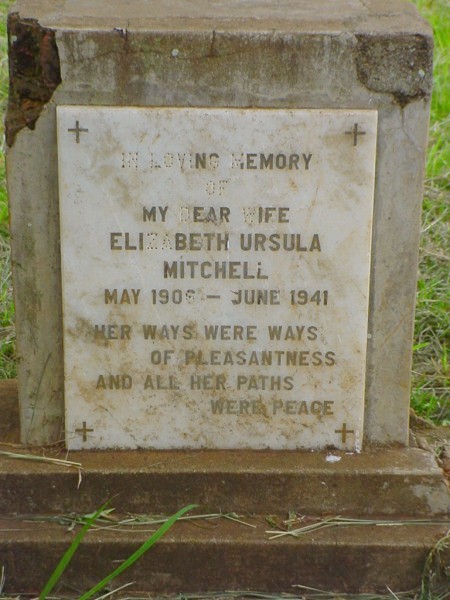
| 117 | Death Her memorial reads: In loving memory of My dear wife ELIZABETH URSULA MITCHELL May 1906-June 1941 Her ways were ways of pleasantness And all her paths were peace | Crawford, Elizabeth Ursula "Libby" (I0427)
|
| 118 | Death Her memorial at In memory of ELIZABETH HATTON, Widow, One of the daughters of Sir WILLIAM SCROGGS, Knight, sometime Chief Justice of the King's Bench First married to ANTHONY GYLBY Esq of Everton in the County of Nottingham And afterwards to the Honourable Sir CHARLES HUTTON, younger son of CHRISTOPHER Lord Hutton of Kirby in the county of Northampton Who died 22 May 1724 Her only surviving son WILLIAM GYLBY Esquire, Recorder of this City, erected this Monument, intending it for her and himself. ------ Here also lyeth the body of the said WILLIAM GYLBY, her son, who died the 10th Day of May 1744, aged 75 years. | Scroggs, Elizabeth (I1688)
|
| 119 | Death Her memorial inscription at St Swithins in Bath reads1: Sacred to the Memory of ANNE, Relict of WALTER NISBET, of the Island of Nevis, Esq and Daughter of ROBERT PARRY, of Llanrhaiadr, County of Denbigh, N.W, Esq. She died December 2nd 1819, aged 67 Years. This tablet is erected by her six surviving children as a Token of their grateful affection. Footnotes [1] St Swithin's Church, Walcot, Bath - Internal Memorials, by PJ Bendall, April 2014, available here | Parry, Anne (I0569)
|
| 120 | Death His will (dated 2 Dec 1776) mentions the Hon. Henry Fane of Berners Street, who I think would have been his cousin Henry Fane, (1739-1802), son of Thomas Fane (1701-1777) who was an MP between 1772 and 1802 and who appears in a portrait with Inigo Jones and Charles Blair (https://en.wikipedia.org/wiki/Henry_Fane_(1739%E2%80%931802)). Alternatively, it could be his uncle Henry Fane (1703-1777) who was also an MP (between 1757 and 1777). But I'm less sure that it was the latter person as I don't see that he is connected to Berners Lane. Later, the will mentions another member of the Fane family: ...to the Hon. Tho. Fane, brother of the present Earl of Westmoreland, & younger son of John the late Earl. At the time of writing the will (December 1776), the Earl of Westmoreland was John Fane, 10th Earl of Westmoreland, son of John Fane, 9th Earl. His younger brother Thomas Fane (1760-1807) must be the person referred to by Gilbert Fane Fleming and would have been Gilbert's first cousin once removed. | Fleming, Gilbert Fane (I2020)
|
| 121 | Death Killed in action, 30 May 1919, on the North-West Frontier of India. | Burn-Murdoch, Colin Thomas (I2498)
|
| 122 | Death Memorial at In memory of Thomas son of John WALTON [of] Nest who died September 2nd 1803 aged 37 years, Also Jonathan WALTON who died November 17th 1799 aged 11 months. Likewise Thomas who died December 4th 1803 aged 11 months both sons of the above Thos Walton, and Elizabeth his daughter who departed this life the --- th day of March 18---- Aged 6 years. | Walton, Jonathan (I1171)
|
| 123 | Death Per Venerandae et indelebili Parentûm Memeoriae Gulielmi Brockman (Hen. Brockman de Beachborough Arm. Filij) tam Dei quam Regis verè Militis aurati, et Annae Conjugis (Sun. Bunce de Otterinden, Juris consulti, Filiae Dominae, Caelo et Terrâ amabilissimae. Quorum Ossa, certâ Spe Resurrectionis, hic substrata, reponuntur. Pietas Filialis Jacobi Brockman, Armigeri hanc tennem, Appendicem, summâ cum Reverentiâ dedicavit, Anno. Dom. 1665. W.B. obijt Dec. 6 1654 A.B. obijt Nov. 29 1660 Which translates roughly as In indelible memory of the venerable parents William Brockman (son of Henry Brockman of Beachborough) a man of God and a true knight; and of his wife Anne (daughter of Simon Bunce of Otterinden, Sheriff), loved equally on Earth as in Heaven. Their bones are stored here in hope of a certain Resurrection. Their dutiful son James Brockman wrote this dedication with the greatest reverence, AD 1665 W[illiam] B[rockman] died 6 Dec 1654 A[nne] B[rockman] died 29 November 1660 Footnotes [1] https://www.findagrave.com/memorial/176483036/anne-brockman | Bunce, Anne (I3169)
|
| 124 | Death The Salopian Journal (6 May 1835, page 2) reads: On the 24th ult, at her son's, Mr James Stephens, Harpton, near Presteign, at the advanced age of 89, Hanna, relict of the late Mr Lawrence Stephens, of Cotmore, Herefordshire, and last surviving sister of Mr Meredith of Birmingham. | Meredith, Hannah (I1642)
|
| 125 | Death The Times of the 20th of May 1915 reported his death: Burn-Murdoch Killed in action, on the 8th May, near Ypres, William Callander Burn-Murdoch, Princess Patricia's Canadian Light Infantry, youngest son of Archibald and Mary Burn-Murdoch, 10 Merchiston Avenue, Edinburgh, aged 26. | Burn-Murdoch, Pvt. William Callander (I1354)
|
| 126 | Death This might be his will: http://freepages.rootsweb.com/~wrag44/genealogy/wills/haywardwills/ThomasCoxalsHayward1626.htm
Will dated 5 Dec 1625 and proved 24 November 1626. Wife Johane matches https://www.selwyn-family.me.uk/genealogy/getperson.php?personID=I69&tree=CurtisHayward His wife Joan may have died 1636: http://freepages.rootsweb.com/~wrag44/genealogy/forthampton/forthamptonbt.htm Bigland's Inscriptions1 notes the following: Here lieth the Body of Thomas COCKES, alias HAYWARD who died the 15th of May 1620 The death in 1620 is problematic if his will was not written until 1625. William Good posited that the actual memorial date was 1626, but that the final 6 was mis-read as a zero by Bigland (who transcribed the inscription nearly 160 years after they were carved. This seems reasonable to me. Footnotes [1] Gloucestershire, Bigland's Monumental Inscriptions, page 610 | Cox als Hayward, Thomas of Forthampton (I2035)
|
| 127 | Early Life & Career The Cambridge Alumni record for Robert lists the following events for him:
The actual Civil War began in 1642. From [Robert Thornton] rector of Birkin, co. York, was eminently distinguished, during the civil conflicts of the reign of Charles I, for his loyalty and attachment to the Church of England. His great and manifold privations in these distressing times are fully related in Walker's A little more "flavour" around his persecution by the puritans comes from GENuki: Of Robert Thornton we learn from Walker's The same website shows that Robert was instituted as Rector on the 29th of March 1612 and secondly on the 20th of March 1664, very shortly before his death. His son, also Robert, succeeded to the Rectory at that time. Family Life Robert married
Death Robert died in 1665 and was buried in the churchyard at Footnotes [1] A tiny bit more info here [2] 4th Edition, page 1505 (Thornton of Birkin and Clapham) | Thornton, Rev. Robert (I2873)
|
| 128 | Early Life and Career From This Gent. was born eldest son to a Gentleman (Archibald Hamilton, of Raploch, in Lanarkshire, who married, first, Marion, daughter of Ogilyy of that Ilk, widow of Weir of Blackwood, and of Dunbar of Blantyre) descended of the Duke Hamilton's family...This Hans, being found a very hopeful youth, of good parts and disposition, was bred at Schools and Colleges so far as was then usual, yet of no other design, but to give him the accomplishments becoming his station and natural endowments. But as it fell out that hwe was drawn to appear for the Queen Regent (Mary of Guise) in arms, in his youth, and by ill advice, he contracted the displeasure of the reforming partya, and thereby, through the malice of the friends of his father's second wife (Margaret, daughter of John Hamilton of Newton) was deprived of the estate whereunto he was born the righteous heirb. a. The Duke of Chatelherault, who had been obliged to resign the office of Regent in favour of the Queen-mother, in a conference with the Lords of the Congregation, agreed to join them in resisting the violent and arbitrary measures of the Queen-Regent against all those who professed the Reformed [i.e. Protestant] faith, which she had hitherto favoured, to which she was instigated by her brothers of the House of Guise. The Duke embarked most heartily in favour of the Congregation, and continued to employ all his powers and influence to support of its measures; and the Earl of Arran (his eldest son) distinguished himself in various encounters with the troops of the Regent in 1559. b. By his uncle, Gawin Hamilton, commendator of Kilwinning, who had a precept of clare constat from James Duke of Chatelherault, for infefting him in the lands of Raploch, of date 3rd March 1559. Having been bred to the Church, he was made Dean of the Metropolitan Church of Glasgow in 1550, which office he soon after exchanged with Henry Sinclair, commendator of Kilwinning, for the commendacy of that Abbacy. He was the intimate friend of and, along with the Archbishop of St. Andrew's, the confidential adviser of the Duke of Chatelherault. He obtained a breviate from the Pope, appointing him coadjutor and successor to Archbishop Hamilton in the see of St Andrew's. On the establishment of the reformed religion in Scotland, he followed the example of many Churchmen of that period, and took to wife Margaret second daughter of John Hamilton, of Broomhill, by whom he had issue, after the marriage, one daughter, Jean, married to Robert Dalziel of that Ilk, ancestors of the Earls of Carnwath; though before that she had a son to him, Gavin, who afterwards became his successor in the lands of Raploch, under a charter of rendition, dated 13th May 1560, granted by the commendator in favour of the above Margaret, in life rents, and to Gavin Hamilton, her son, in fee, which charter was confirmed on the day following by James Duke of Chatelherault. Gawin, commendator of Kilwinning, was slain in a skirmish between the Queen's troops and the forces of the Regent Lennox, 28th June 1571 Family Life Hans married, in 1533,
Both Gawin and Patrick are direct ancestors. Death The following text is commonly found online; the author appears to be Jill Stevenson but I have no further details about its original source. The Tomb of Hans Hamilton You'll never see it if you are just driving past, but there is a wee surprise for historians at the back of the Clandeboye Hall. (the little building at the front left of the Kirk) in memory of Hans Hamilton, the very first Protestant minister of Dunlop, there is an unassuming looking mausoleum holding the graves of the minister and his wife. Standing about 12 feet by 10 feet it is constructed of the same type of stone as the Kirk itself, ashlar. It was built by the Hamiltons son, James Viscount Clandeboye. The tomb is very difficult to view due to the lack of light falling into it. Inside is a marble recess with a curved roof. Statues of a man and woman depict Hans and his wife, both kneeling towards each other with hands raised as if in prayer. The entire recess holding the tomb appears to be behind curtains, skillfully carved in stone. Overall it is an interesting piece but is a photographers nightmare. The gauge of the steel mesh door wouldn't allow a finger to pass through let alone a lens. So for now - no piccies of the interior. Inside there are a number of inscriptions on most of the walls and the tomb itself. Below is a transcript of the words as kept in historical records at the Dick Institute Kilmarnock. Tombstone Inscription Heir lyes the bodies of HANIS HAMILTON, sonne of ARCHIBALD HAMILTON of Raploch, servant to King IAMES THE FIFT, & of IANET DENHAM his wife, davghter of IAMES DENHAM, laird of West-Sheilde, they lived maryed together 45 yeers, dvuring which tyme the said Hans served teh cvre at this chvrch. They were mvch beloved of all that knew them, & especially of the parishioners. They had six sonnes, Iames, Archibald, Gavin, Iohn, William & Patrick, & on davghter, Ieane, maryed to William Mvuire of Glanders tovne. The dvst of two lives in this arte-fvll frame, whose bvrth them honor'd. From an honored name, a painefvll pastor, and his spotles wife, whose devovt statves embleme here there life blest with the height of favors from above, blood, grace, a blest memorial, all men's love. A frvitfvll ofspringe on whom the lord hath fixt fortvnes with virtve, and with honor mixt, then live these dead above in endles ioyes, heere in their seid and noble Clandeboyes in whom (gravnt soe, o heavens) their honored name may never die, bvt in death of fame. Rom. 8 ch. ver. 18 - The afflictions of this life are not worthie of the glory which shal bee shewed vnto vs. Prov. 31 ch. ver. 10 & 30 - The price of a vertvovs woman is far above pearles. A woman that feareth the lord shal bee praised. Dan. 12 ch. ver. 3 - They that tvrn many to righteovsnes shall shine as the starrs for ever and ever. This mortall mvst pvt on immortallity, 1 Cor. 15 & 53 --------------------------------------- Heir Lyis HANES HAMMILTOVN Vicar of Dvnlope qvha deceisit ye 30 of Mah 1608 of ye aige of 72 zeirs and of IONET DENHAME his spovs Heir restis the bodie of IONET MAXWELL spovs to Maister Hew EGLINTOVN minister of Dvnlop qvha deceisit the 30 of Ianvar 1628 Ivstvs Fide Vivit The same tombstone inscription is mentioned in the Under a marble arch, within two pillars of the composite order, in front are two statues kneeling on a marble monument, in the attitude of devotion, and habited according to the fashion of the times. There is also a long inscription on a marble slab in the wall, stating that he was the son of Archibald Hamilton of Raploch, and that his wife was Janet, second daughter of James Denholm of Westshiells; that they lived together 45 years, during which period he had served the cure of the church; that they had six sons, and one daughter, Jean, married to Mure of Glanderston; and other particulars. It appears to have been erected by their son, James, first Viscount Clanebois, from whom came the Earls of Clanbrassil who became extinct in 1798. Footnotes [1] [2] Note that this JSTOR article (note #3) says her name was Margaret, not Janet. But Janet is confirmed by the memorial inscription. [3] | Hamilton, Hans (I2129)
|
| 129 | Early Life "A scion of one of the most respectable families in the West of Scotland" ( From boyhood he took an interest in ecclesiastical affairs; and, on the 23rd of July 1637 — when the famous Janet Geddes threw the stool at the head of the Dean of Edinburgh as he was proceeding to introduce the Service Book, and when the promoters of the Liturgy were balked by a mob of women — Patrick Adair was in the Scottish metropolis, and a witness of the uproar. From Patronymica Brittanica1: ADAIR. A branch of the great Anglo-Hibernian family of Fitz-Gerald settled at Adare, a village in co. Limerick, and thus acquired the local surname. In the XV century Robert Fitz-Gerald de Adair, in consequence of family feuds, removed to Galloway, in Scotland, and dropping his patronymical designation, wrote himself "Adair" a name which has since ramified largely on both sides of the Irish Channel. In temp. Chas. I., the senior branch transferred themselves from Galloway to co. Antrim, where they resided for some generations, until on the acquisition of English estates they again settled in Britain. The migrations of the family may thus be stated:
From: Patrick Adair of Cairncastle: The Adairs of the North of Ireland, of whom the eminent Presbyterian minister above named [i.e. Patrick Adair] was one, and whose present head had been ennobled under the title of Lord Waveney, are commonly said to be of Scotch extraction. And they certainly did come from Scotland to Ireland in the seventeenth century. But it is equally certain, although not so well known, that, like most ‘Scots’ (so called), they had previously gone from Ireland to Scotland. Their family name originally was not Adair, but Fitzgerald, and their founder was a young man called Robert Fitzgerald, a son of the Earl of Desmond. This Robert Fitzgerald lived in the latter part of the fourteenth century, and was the owner of the lands of Adare, in the South of Ireland. Having, in a family feud, killed a person of distinction, he was obliged to leave his native country. He took refuge in Galloway, in Scotland, where he assumed the name of Adare, or Adair, from his forfeited Milesian patrimony, and obtaining for himself, by means which were not uncommon in those days, a Scotch estate in place of the Irish one he had lost, he founded a family, which, for some time, was known as the Adairs of Portree, afterwards of Kinhilt, and, most recently (on their return to Ireland), as the Adairs of Ballymena, in this country, where they have been for many generations respected and beloved. Career Patrick entered divinity classes at Glasgow College in 1644 and when licensed, he went to Ireland as a preacher; and on the 7th of May 1646 he was ordained to the pastoral charge of the parish of He wrote From The Rev. Dr. James Kirkpatrick, the author of Presbyterian Loyalty, was the son of a Presbyterian minister well acquainted with [Patrick Adair] and [had] himself [moved to the] congregation over which Mr. Adair presided in Belfast about twelve years after [the latter's] decease. He is, therefore, competent to bear testimony to the character of his distinguished predecessor. His attestation is remarkable. " Mr. Adair," says he, " was a man of great natural parts and wisdom, eminent piety and exemplary holiness, great ministerial gravity and authority, endowed with savoury and most edifying gifts for his sacred function, wherein he was laborious, painful, and faithful ; was a constant, curious, and accurate observer of all public occurrences ; and, with all these rare qualities, he had not only the blood and descent, but the spirit and just decorum of a gentleman." Family Life
There are whole dynasties of Adairs in America, some of whom are genetic cousins of ours - it's possible that many of these are descendends of Archibald, Alexander or Helen. Death From Patrick Adair of Cairncastle: His will was dated 26 January 1693, but probate was not taken out until 6 July 1695, more than a year after his death. ‘In his will’ says Classon Porter, ‘Mr Adair mentions a sum of four hundred pounds belonging to him which was in the hands of Lord Donegall, and the interest of which he leaves to his wife as a jointure.’ This was his third wife, Elizabeth Anderson, a widow whom he married while he was minister at Belfast. Her maiden name was Martin. He had four sons: William, Archibald, Alexander and Patrick, and a daughter, Helen. Gordon says that Patrick junior was a minister at Carrickfergus and that he died in June 1717. William, his eldest son by Margaret Cunningham, was an executor of his father’s will, and his third son Alexander, a witness to it. ... By which wife Patrick Adair had his second, third and fourth sons, and his only daughter, we do not know. Possibly they were all born at Cairncastle, for Adair was fifty years of age when he relinquished his charge there. He was buried in Belfast in accordance with the terms of his will; but (says Porter) ‘we have not heard of any monument of any kind having been erected to this faithful pastor, this brave sufferer for what he believed to be the truth, this able negotiator, this honest man.’. No likeness of Patrick Adair has survived – if indeed any was ever drawn or painted. Footnotes [1] Patronymica Brittanica, A Dictionary of the Family Names of the United Kingdom, Mark Anthony Lower, London 1860 [2] https://en.wikipedia.org/wiki/Patrick_Adair [3] A True Narrative of the Presbyterian Church in the North of Ireland, Patrick Adair, edited by WD Killen, Belfast 1866 [4] There are some disagreements on the order of marriage. The DNB (1921, pages 72-73) has him marrying first Jean, then Elizabeth Anderson, but doesn't mention Margaret Cunningham. Adair History & Genealogy (J Barnett Adair, page 25) only mentions Jean. Antrim History makes Margaret Cunningham his first wife with a marriage in 1650, Jean second and Elizabeth Anderson 3rd. This source is clear that his son William was by Margaret Cunningham, and he was the eldest. [5] Adair History & Genealogy, J Barnett Adair, Los Angeles, 1924, page 34 | Adair, Rev. Patrick (I1347)
|
| 130 | Early Life Wikipedia has Career & Family Life From the A steady loyalist (sometime in command on the coast of Africa). A man of parts and merit, who, having betaken himself to a military life, had a considerable command upon the coast of Africa, where, after a defeat, he was taken prisoner by the barbarians, and when he was upon the point of being destroyed by them, was ransomed by a lady, whose picture, with a coronet on her head, and a landskip [sic], representing his deliverance, is still preserved in the family. These additional details are from He returned to Britain in the reign of King Charles I, and being a steady loyalist, and a brave officer, joined the royal army in England, had the honour of knighthood conferred upon him by the king, and had a considerable command in the army; which appears by these words in Ludlow's memoirs, p. 27: The earl of Newcastle sent a detachment of horse and dragoons towards Bolton, by their standards appearing to be about eightyseven troops, commanded by Sir John Henderson, an old soldier It rings odd for him to be described as 'an old soldier', given that John died aged just 45 (see below). John married
The names of the remaining four daughters are not given in the Death John died on the 11th of March 1650, aged just 45. Footnotes [1] [2] [3] Further info in Red Book of Scotland vol. 5 needs to be reviewed | Henderson, Sir John of Fordell (I1780)
|
| 131 | Early Life We find a baptismal record for a Family Life Christopher married
There was probably at least one other child between Joseph and John but I have not found the baptismal records. Death Christopher died on the 2nd of February 1739 in Leeds. A memorial at Sacred to Memory Christopher DARNTONnd February 1738, SUSANNAH, his wife died in March 1742. John DARNTON, their son died 1st May 1759, aged 49 years. ANN his wife died 30th Decr 1752, aged 38 years. CHRISTOPHER son of John and Ann DARNTON died 19th April 1751, aged 15 days. SARAH, a daughter, died 8th Decr 1763, aged 19 years. HEPHZIBAH, another daughter, died 28th October 1766, aged 20 years, and was interred at Northorp Church, Lincolnshire. ANN, another daughter, died 5th March 1788, aged 46 years | Darnton, Christopher of Briggate (I2996)
|
| 132 | Early Life Family Life Footnotes [1] Dugdale's Visitation of Yorkshire, With Additions, ed. JW Clay, Exeter (1899); Portington of Barnby-super-Don, Vol. 2, page 422 Dugdale also has a Copley pedigree on page 154, showing Mary, daughter to John, marrying "John or Thomas Portington" [2] Ducatus Leodiensis: or, the Topography of the Ancient and Populous Town and Parish of Leeds, Ralph Thoresby, London (1715); Portington, page 100 Ducatus also has a Copley pedigree (page 9) but I don't find Mary daughter of John. [3] Pedigrees of The County Families of Yorkshire, Compiled by Joseph Foster, Volume 2 (West Riding, M-Z), London (1874); Portington of Barnby-upon-Don [4] The Visitation of Yorkshire In the Years 1563 and 1564, by William Flower, ed. Charles Norcliffe, London (1891); Copley, pages 78-79 | Portington, John of Barnby Don (I3791)
|
| 133 | Early Life Margaret->James Stewart of Ardgowan and Blackhall->skips generations->Robert III Margaret->James Stewart of Auchingoun, Blackhall & Ardowan + Janet Maxwell->James Stewart + Janet Kennedy->John Stewart+Marion/Janet Mure->John Stewart+Elizabeth Lyle->James Stewart->John Stewart->John Stewart Robert III died in 1390 and | Stewart, Margaret (I2135)
|
| 134 | Early Life I have kept in the link for now, but consider it suspect. Footnotes [1] Kelso of Kelsoland, by Clarence E Kelso & Wilber M Kelso, Private publication, 1935 | Livingston, Eleanore (I2143)
|
| 135 | Early Life The Others have also had some trouble establishing exactly who Alice's father was: see here. The author of this thread suggests that Alice's father Roger was actually the great-grandfather of the Roger I describe above, and who is shown in the Footnotes [1] Lincolnshire Pedigrees, Rev. Canon AR Maddison, Volume 3, Harleian Society (1904); Tyrwhit of Kettleby, p1018 [2] Visitation of the County of Lincoln in 1562-4, ed. Walter C Metcalfe, London (1881); Kelke, p72 | Kelke, Alice (I2587)
|
| 136 | Early Life Career Adam was a merchant in Burgess and Guildbrother, merchant, as eldest son to Hector R., merchant, Burgess and Guildbrother. This link suggests he exported 2,000 barrel staves to the West Indies in 1611. More details are found in an article in The Mariner's Mirror, volume 79, Issue 1, entitled "Scotland and the Atlantic: the Voyage of the Jonet of Leith, December 1611", which includes: Of the two, Adam Rae was by far the richer man. On his death, he left in "frie geir", his debts 'deducit' over £11,000 Scots. Much of this was made up of monies owed to him by major Scottish landowners, including Archibald, Earl of Argyll. He was therefore a man who had wide-ranging connections in Scottish society. Family Life Adam married
See Death below for mention of a possible fifth daughter, Marjorie. Death The entry at Ray's Tomb suggests Adam died in 1616. However he is recorded as the father of This page which lists heirs coming into property suggests that Anna inherited lands from her father on the 21st of July 1618, so he must have died prior to that date. That same site suggests he had three surviving daughters in 1618: Anna, Elizabeth and Helen. The article quoted above in Career indicates Adam died in May of 1618, which is the date I'll settle on. Finally, a will for Adam is recorded dated 8 December 16193. Finally finally, I think there has been a confusion in some pedigrees with a separate Adam Ray of Edinburgh (who married Helen Scot) who lived at almost exactly the same time. Footnotes [1] The name Hector appears on the tomb and in a burgess record for Adam [2] [3] [4] For the registration of his coat of arms, see Scottish Arms | Rae, Adam of Pitsindie and Canglor (I2207)
|
| 137 | Early Life Footnotes [1] Lots of family details at Brough Family Organization | Brough, Agnes (I1720)
|
| 138 | Early life In the 1871 census, when Agnes was four, she is listed with her parents at 28 Priory Road in St John Hampstead. However, by the 1881 census when she should have been 14, she is not listed with her parents, so may have been at boarding school. In fact, Agnes disappears from both the 1881 and 1891 censuses and only reappears in 1901, after she has been married (and widowed). Family life Agnes married at the age of 28, on the 16th of July 1894 in India, to Agnes and Hugh had three children whilst they were in India:
Agnes' husband Hugh died of pneumonia on the 18th of March 1901 in Lanouli, Bombay. Agnes and her children must have already been in England as they were recorded at her parent's house in Wimbledon in the 1901 census. At some point soon thereafter she moved the family to their own house, 2 Thornton Hill in Wimbledon. In the 1939 register she is recorded staying with her brother Walter Selwyn at Hale Farm House in Ringwood, Hampshire (presumably to get out of London during the bombings). At some point she moved to Crow Cottage in Ringwood, perhaps to be near her brother and sister-in-law and stayed here until she died. Death Agnes died on the 13th June 1955 at the Will Agnes' will was dated the 16th of June 1951 and in it she makes a few bequests:
Footnotes [1] This church has since been demolished. | Nisbet, Agnes Lockhart (I0212)
|
| 139 | Early Life A note on Ancestry from user passerelledei reads as follows: Alan Lupton studied at the Pestalozzian School situated at 35-37 Potter Street Worksop (now the Masonic Hall). The school was founded by Benjamin Hildenmaier and based on the methods of scientific education developed by the Swiss educationalist Johann Heinrich Pestalozzi. At one time, under the Principalship of Dr Ellenberger, its students included two brothers of the Khedive of Egypt. The construction of Queen Street severely impacted on the school's recreational space and it was eventually forced to close. Career Alan followed his father and grandfather into trade, becoming a cloth merchant in Mr Lupton...was the third son of the late Darnton Lupton, the head of a highly successful cloth firm in Leeds, which Mr Lupton joined after being educated for the Army. Endowed with great shrewdness and boundless activity, he made a fresh success of the business, from the continuance of which he was ultimately incapacitated by a railway accident. He regained health and strength from outdoor life, to which he was passionately devoted, becoming a fearless rider to hounds, an enthusiastic four-in-hand driver, and a bit of a farmer. To within a few weeks of his death he had thrown extraordinary energy into the development of a large estate in Skye belonging to his son-in-law, Mr William [sic, they meant Walter] Johnson, now on active service. In recent years Mr Lupton had concentrated his business energy on the affairs of this firm (HR Baines and Company), in which he had inherited a financial interest, and he joined the Board in 1907, becoming Chairman in 1917. He gave unremitting attention to the business of the firm, and in the midst of it never ceased to show an intensely human interest in everybody connected with the house. He was deeply interested in the War, doing his bit in the way of looking after remounts, which his only son - Mr Alan Cecil Lupton, now in Mesopotamia - and others had been buying in the United States for the Government. Mr Lupton was tall, spare and exceedingly handsome, and displayed all the characteristics of the typical Yorkshireman. Family Life Alan married
When Alan's daughter Death Alan died on the 23rd of February 1918 in In many widely different places the death of Mr Alan Lupton will be felt as a personal loss. On the Bench at Ripon and in the West Riding, in the Coaching Club and the Four-in-Hand Club, and in the hunting field - in all these he will be sorely missed. A man of distinguished charm of manner, urbane, witty, and delightful in his conversation, and kindly in all his thoughts and actions, Mr Lupton was a man who made many friends and never an enemy....Driving his perfectly-matched teams in the Park, or riding hard to hounds in his beloved Yorkshire, Mr Lupton was an English country gentleman of the very best type. And in the country where Peel's "View-Halloa" would awaken the dead he was laid to rest last week in a little village churchyard some miles from Ripon - buried there by his own wish, so that he might "still hear the hounds coming by in the morning." Footnotes [1] Obituary in The Graphic, 2nd March 1918, page 260. NB The Graphic was owned by HR Baines, the company that Alan became the Chairman of. [2] Obituary in The Bystander, 6th March 1918, page 490. Like The Graphic, The Bystander was owned by HR Baines. | Lupton, Alan (I0217)
|
| 140 | Early Life Family Life Albinia married the Rev. Death Albinia died on the 19th of May 1860 aged 87 and was buried at Quedgeley. Hayward Surname From Fr. haie, a hedge, and ward, O. Eng. a guardian or keeper. Inclosures as well as the fences which encircled them were called hays; hence a Hayward was a person employed to watch enclosed fields. "I have an home and be a Hayward And liggen out a nyghtes, And kepe my corn and my croft From pykers and theves." Piers Plowman. Jacob defines it as "one that keeps the common herd of cattle of a town;" and adds: "the reason of his being called a hayward may be because one part of his office is to see that they neither break nor crop the hedges of enclosed grounds, or for that he keeps the grass from hurt and destruction. He is an officer appointed in the lord's court for the due execution of his office." Law Dict, in voc. Footnotes [1] William Hayward Winstone was born William Hayward, but adopted the surname Winstone on receiving an inheritance from his uncle, Thomas Winstone of | Hayward, Albinia Frances (I0846)
|
| 141 | Early Life From ... 'was ane prodigal man, not gewen for the well of his hows.' He left Scotland in 1489, having quarrelled with his wife, taking large sums of money with him. When or how he died is not known; neither he nor his money was ever heard of, and it was supposed that he had been robbed and murdered. He married Elizabeth, daughter of Sir David Guthrie of that Ilk Footnotes [1] The Scots Peerage, by Sir James Balfour Paul, Volume 7, Edinburgh (1910); Maule, Earl Panmure | Maule, Alexander (I2977)
|
| 142 | Early Life Career Ambassador to England 1485, fought for James III at Sauchieburn 1487, was designated in his father's lifetime Alexander of Garlies, which continued to be the chief title of the family until they were made Earls of Galloway. Succeeded his father in 1479-80. He was an adherent of his cousin Sir John Stewart of Darnley, and occurs in a declaration made at Edinburgh on 10 October 1482 by King James III exonerating Sir John and his followers for having seized and carried him to Edinburgh Castle3. He was Ambassador to England about he year 1485, and supported James III at Sauchieburn against the rebel lords in 1488. Family Life Alexander married Death Alexander died c. 1500. Footnotes [1] [2] [3] In attempting to lead his subjects against and English invasion, James was arrested by a group of disaffected nobles at Lauder Bridge in July 1482 and imprisoned at Edinburgh Castle. | Stewart, Sir Alexander 3rd of Garlies (I1907)
|
| 143 | Early Life From From this point onwards in the Bosville history we get the valuable help of the Rev. Joseph Hunter, who has much to say of Bosvilles in his ... The seal of Alicia, John’s wife, is also in existence; the device a fleur-de-lis with the inscription surrounding it, "S ALIC’ D’ BOSVIL." Part of the deed, to which this seal is affixed is a quit-claim in her free widowhood to "Peter de Boysevil, qui est Dominus feodi" of a pound of pepper (the word is cyminus) which Peter ought to pay for de Bykerthorp and Scotrode. Footnotes [1] | de Darfield, Alice (I3042)
|
| 144 | Early Life In Sister and heir of Thomase Eustace of Highgate, & buried in St Botolph's, Aldersgate. A pedigree of the Eustaces at British History Online (Appendix V: Pedigree of Eustace and Hart) gives her father as Both Alice's father Giles and her brother Thomas are mentioned in the Giles Eustace, mentioned in 1462, and an illicit brewer in 1480, acquired the Cornerhouse, beside High Street, in 1490. Two houses stood there when he made his will in 1495 and a brew-house and horse-mill were leased by Family Life Alice married Death Given that Alice was heir to her brother Thomas, and Thomas was alive in 1525, she must have died after 1525. Footnotes [1] The Family History of Hart of Donegal, by Henry Travers Hart, London, 1907 | Eustace, Alice (I2270)
|
| 145 | Early Life Death Alice died on the 11th of June 1776 at Previously unpublished letters in the possession of the family give a full account of the accident. On Saturday 8th June 1776 Wadsworth and Alice Busk set out to visit Newtown which they had intended to move into from their cramped lodging at Snugborough on the following Tuesday. They were delayed in setting off as Wadsworth Busk had mislaid some bank notes and as they were leaving their landlady gave them two chickens which were given to the boy who was to accompany them. As Richmond Hill is very steep Mr Busk as usual, got out of the chaise and walked up the hill to save the horse - one of the chickens escaped, the boy alighted to capture it, and, possibly due to the noise of the chicken, the chaise horse bolted, Mrs Busk was thrown out and one of the wheels of the chaise went over her back, presumably breaking it as she lost the use of her legs. She was taken back to Douglas and died on Tuesday 11th June having been in great pain. Wadsworth Busk was greatly affected by his loss - on August 4th he wrote to his brother in law Rev E Radcliffe (who also appeared to act as his personal agent in London) saying "so far I have not been able to write to any of them [his friends], nor can I foresee when I shall. My nerves are in so shattered a state that I can hardly hold my pen, and my Rheumatism is so bad that it is not now without difficulty that I walk across the room" - however he went on to ask Radcliffe to find him a tutor for his boys (£50 a year plus board) and concludes with some business matters. In a subsequent letter he writes "never did I know the true value of the treasure that is gone till I lost it". In a letter of the 17th Dec he asks Radcliffe's opinion on two possible wordings for the his wife's memorial (in Onchan churchyard) - however as both of them are considerably shorter and much simpler than that reported by Feltham it appears that he must have considerably altered his first thoughts. The memorial, recorded by Feltham, reads: Alice Busk, wife of Wadsworth Busk, Esq., Attorney-General of the Isle, on the 11th June, 1776, in the 38th year of her age. Her valuable life was suddenly lost By a fatal and deplorable accident: To the heart rending grief Of one whose happiness, lies buried here: Whose health, whose ease, whose comfort was her care, Whose inclinations ere his lips had uttered them, She caught even from his eye, and regarded as a Law; Whom to the last she hundred with her love, And having blest him while she lived, Blest him also with her expiring breath. On his distracted mind, the virtues she possest, Have too deeply stamped the remembrance Of her untimely death; tho' submitted to by herself In the most calamitous circumstances With a degree of fortitude and resignation, Which Christianity only could inspire; And which reflected a lustre On her sex, her character, and her religion. | Parish, Alice (I1242)
|
| 146 | Early Life Career & Family Life Andrew was Lord of the Bedchamber to Note that Andrew married Death Andrew died at the Battle of Flodden Field on the 9th of September 1513. Footnotes [1] [2] | Stewart, 2nd Lord Avondale Andrew (I1798)
|
| 147 | Early Life a) 4 Jun 1731 at Hythe St Leonard, to Edward Andrews and Anne b) 12 jun 1732 in Kent to James Andrews and Elizabeth c) 14 Nov 1731 in Wittersham, to Edward Andrews and Ann The parents given in a) are also given in this blog page. Family Life Ann married Death Ann died in November 1807 and was buried on the 11th in
Footnotes [1] Her year of birth is given in the parish record for her marriage, wherein she is stated to have been aged 24 in April 1756. https://discovery.nationalarchives.gov.uk/details/r/D161630 apparently married Anne Andrews' sister Mary and his will might have bequests to Anne's Gipps children https://discovery.nationalarchives.gov.uk/details/r/D330282 is the brother of Anne Andrews - his will might mention Anne? | Andrews, Ann (I2145)
|
| 148 | Early Life Origin of Busk surname The Busk name originated from Anna's great-grandfather, One such argument was made in It may interest PROF. SKEAT2 to know how Busk as a surname (to which he alludes) came into being. It was reduced to that form of spelling by my great-grand father, Jacob Hans Busk. The family had for generations been designated in Normandy as Du Busc, having for bearing a tree ppr. on a field argent. My late brother’s papers have not come into my hands, but he had evidence of the existence of the name in Norman records so far back as the year 1315. Nicolas du Busc3 was sent to Sweden as French ambassador in 1659, ultimately settling and residing there till his death, about 1708. Either he or his son Hans Hanssen added a final k, probably out of conformity with local fondness for that letter, making it Busck. Hans Hanssen Busck’s son, Jacob Hans Busk (at that time Busck) above named, came to England in 1712, and was naturalized 8—9 George I. Being both a practical and a humorous man , he said he would save his descendants the trouble of writing two letters henceforth where one answered all the purpose, and accordingly reduced the spelling to Busk. This entry was signed R.H Busk, which might be Rachel Harriette Busk, daughter of Hans Busk (who was a grandson of Jacob Hannson Busk). The brother she alludes to might be Hans Busk, her eldest brother.If PROF. SKEAT'S researches have brought him across any earlier instance of "Busk as a surname", so spelt, it would interest me much if he would kindly tell me of it. There are several arguments against this (mostly put together by Wilhelm Berg, who wrote the
At the time of Footnotes [1] Notes & Queries, 7th Series, Vol. 1, p. 14 (https://archive.org/details/s7notesqueries01londuoft/page/14) [2] The abovementioned Professor Skeat's originally letter is here: https://upload.wikimedia.org/wikipedia/commons/thumb/c/cc/Notes_and_Queries_-_Series_6_-_Volume_12.djvu/page443-1024px-Notes_and_Queries_-_Series_6_-_Volume_12.djvu.jpg [3] https://www.geni.com/people/Nicholas-du-Busc/6000000019750391465 | Busk, Anna Jane (I0324)
|
| 149 | Early Life Family Life Anne married
| Dalyson, Anne (I2254)
|
| 150 | Early Life That same Henry had another daughter called Susan, baptised in 1653; in that record his wife is recorded as Sarah. It seems that Anne had a brother, Henry, who married (also in Hackington, where Anne later married We can also see that an Anne Bunce married a Henry Landman: there are two dates, 16 Feb 1659/60 at Ashford St Mary, and 18 Feb 1660/61 at Wye St Gregory. The Bunce family is connected to the Gipps family via Simon Gipps' aunt, who married James Bunce. | Landman, Anne (I3105)
|